When using a note-taking tool such as Obsidian, or even plain notes, there is complete freedom in how to set up the system. The tool does not care what I enter or where I enter it and there is no validation for correct or missing fields.
Thankfully, using Obsidian and a bit of thinking I can create a set of quality assurance Obsidian bases that will at least inform me of any exceptions.
Step 1—Know the rules
Every one of my Books index, Movies index, TV shows index shows and Video games index that I’ve completed should have a star rating. I can partially ensure this by adding a rating property to a template but that does not mean the value is set: just that I’ll notice it empty.
Step 2—Limit the search
If books, movies, tv shows and video games must all have a rating, then what about other note “types”. I don’t want to pollute the results with all the notes that don’t, and should not have, a rating.
In The Quantum Garden Vault I do this by using my class tags.1 Those I need are:
#class/book#class/movie#class/tv-show#class/video-game
Step 3—Create the base
With an Obsidian base in front of me, I can achieve what I need by creating this filter.
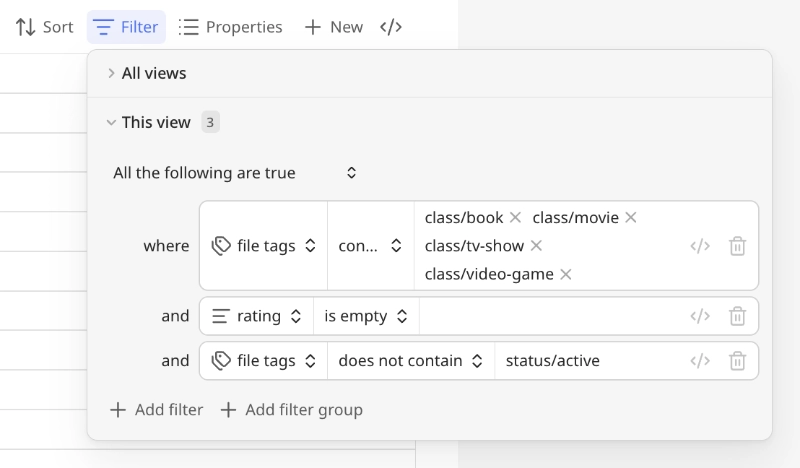
- I filter for only those note types I want (the cut-off central dropdown on the row is “contains any of”)
- I am only concerned where rating is empty (also triggers if missing)
- I filter out Active books, games, etc., because these won’t have rating until I’ve Completed them.
Step 4—Extend the system
It’s possible to extend this system pretty much indefinitely. For books I could check for a missing author, or if I was to be doubly sure of my data quality I could check for the presence of an author field with #class/book missing. That would identify any books not tagged correctly.
The Identifying missing true or false Obsidian properties describes checkboxes as a special case.
Footnotes
-
See the class tags in Quantum OS Tagging Conventions. ↩