In his book Outliers, Malcolm Gladwell proposes that to be an expert in something takes 10,000 hours. That’s a lot. A real lot.
I can track the beginning of My mediation practice to October 2016 when I first met with a psychologist who recommended I begin meditating daily. For most of the days between now and then I have mediated using guided meditation applications which track the minutes spent. Though I now only meditate on work days, that’s still 150 minutes or 2.5 hours per week.
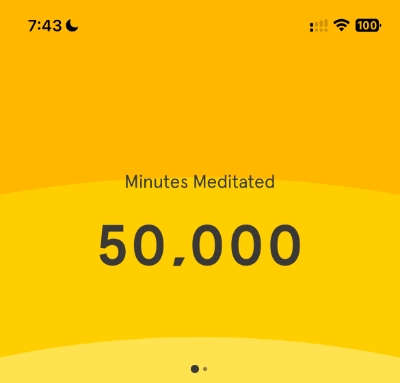
Headspace logged the final minutes of 50,000 on this year. I admit cutting my standard 30 minute session down to 20 for a nice round figure.
50,000 minutes = 833 and a bit hours. Significantly below the 10,000 hours Gladwell talks about. It took me 2,800 days or 7 years, 8 months. At my average of 17.85 minutes/day, it will take me another 84 years and 5 months1 to achieve expert meditation. Let’s not pull any punches. At north of 130 years old, I’ll be dead by then and my mind wandering is unlikely to be much of a concern.
What do my meditation numbers tell us?
Firstly, 10,000 hours is a long time. Pretty much a lifetime of regular daily practice if you are trying to fit it in around everything else. So much that by the time we get there, it’s unlikely we can put to practical our newfound expertise. I can cut my remaining time to 50 years by sticking to 30 minutes a day. (Note to self: Don’t party too hard for my 100th as I’ll need energy for my “expert achieved” party a few years later.)
Secondly, there is a risk that we get trapped into believing 10,000 hours is necessary before benefit arises. Patently false, but discouraging if left to fester. There is much in my meditation practice I can improve, yet I know the benefits were there from day one. Now, I can drop into a meditative state pretty much anywhere and ignore all that’s going on around me.
Thirdly, we can consider someone with 5 years experience in a domain of knowledge an expert, if they’ve worked on it for every weekday of that time.2 More likely expert status accrues at 15-20 years which accords with what we generally equate to the experience of an expert. Good to know that anyone with less than 5 years experience can’t yet be an expert (shout-out to all the newly minted generative AI experts out there).
Fourthly, “expert” is an assessment made against a standard and a standard which is probably quite nebulous. What one person calls an expert another may call incompetent. It takes only moment to reflect on the past few years of COVID and election media coverage to find an example of these opposing points of view.
Finally, you don’t need that much time to “git gud” or even “really gud”. All you need is to be better than the day before. And that’s only if you can. Self-compassion goes a long way towards feeling good about your efforts, no matter who or what standard you are comparing yourself to.
I say throw the 10,000 hour “standard” out with the 10,000 steps you’re trying for each day. Do what you can and be content. If it makes your heart sing, nothing else matters.